Sites and interactive tools that have to work on opening day — designed, built, and shipped by the same South Florida shop that fabricates the physical build.

A brochure site and a quote form asks a visitor to take your word for it. That works when the claim is easy to believe. When the claim is a number — a saving, a size, a payback period — the visitor has heard it from four other companies that week, and another paragraph will not move them.
So we build the thing that shows it. Below is a site where the entire argument is made by four tools doing arithmetic on the visitor's own utility data, with no sales visit attached.

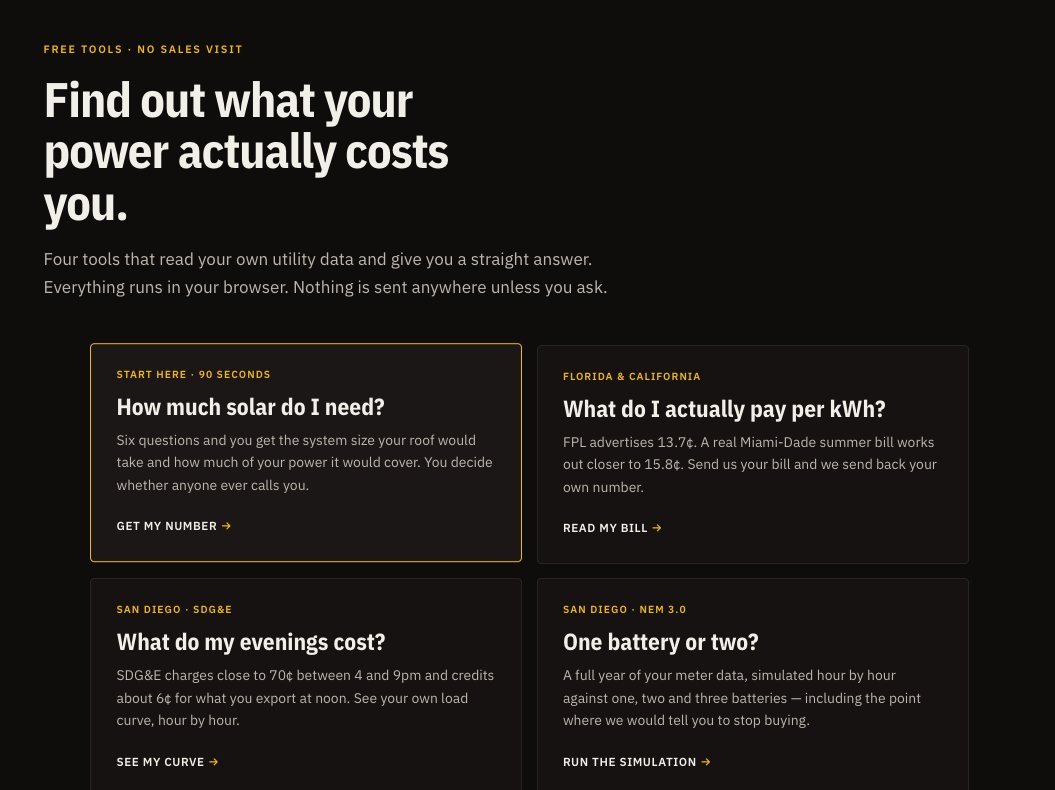
VP Energy is a Sunrun Certified Partner working South Florida and San Diego. Instead of a brochure site with a quote form, we built four working tools that read a homeowner's own utility data and hand back a straight answer.
Everything runs in the visitor's browser. Nothing is sent anywhere unless they ask for it — and none of the tools quotes a price or promises a saving. Each one offers a real engineer at the end, only if the visitor wants one.
View the live site
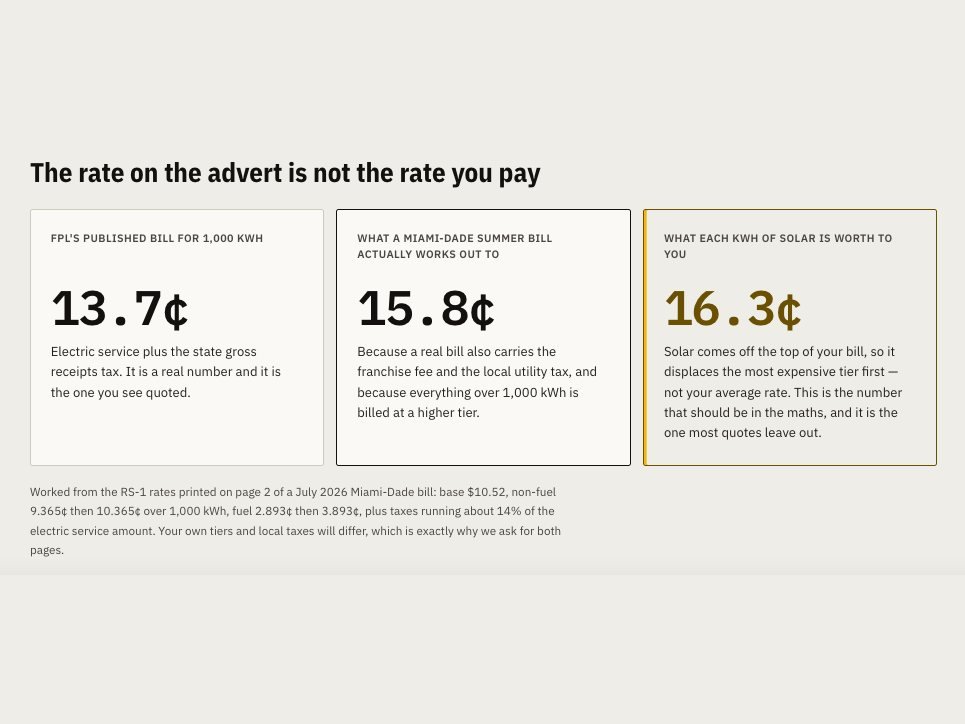
FPL advertises 13.7¢ per kWh. A real Miami-Dade summer bill works out closer to 15.8¢ once the franchise fee, the local utility tax, and the higher tier above 1,000 kWh land. And each kWh of solar is worth 16.3¢, because it comes off the top of the bill and displaces the most expensive tier first — the figure most quotes leave out.
This is the one place a visitor hands something over: they send the bill, and they get a one-page summary back. No appointment to get the analysis.

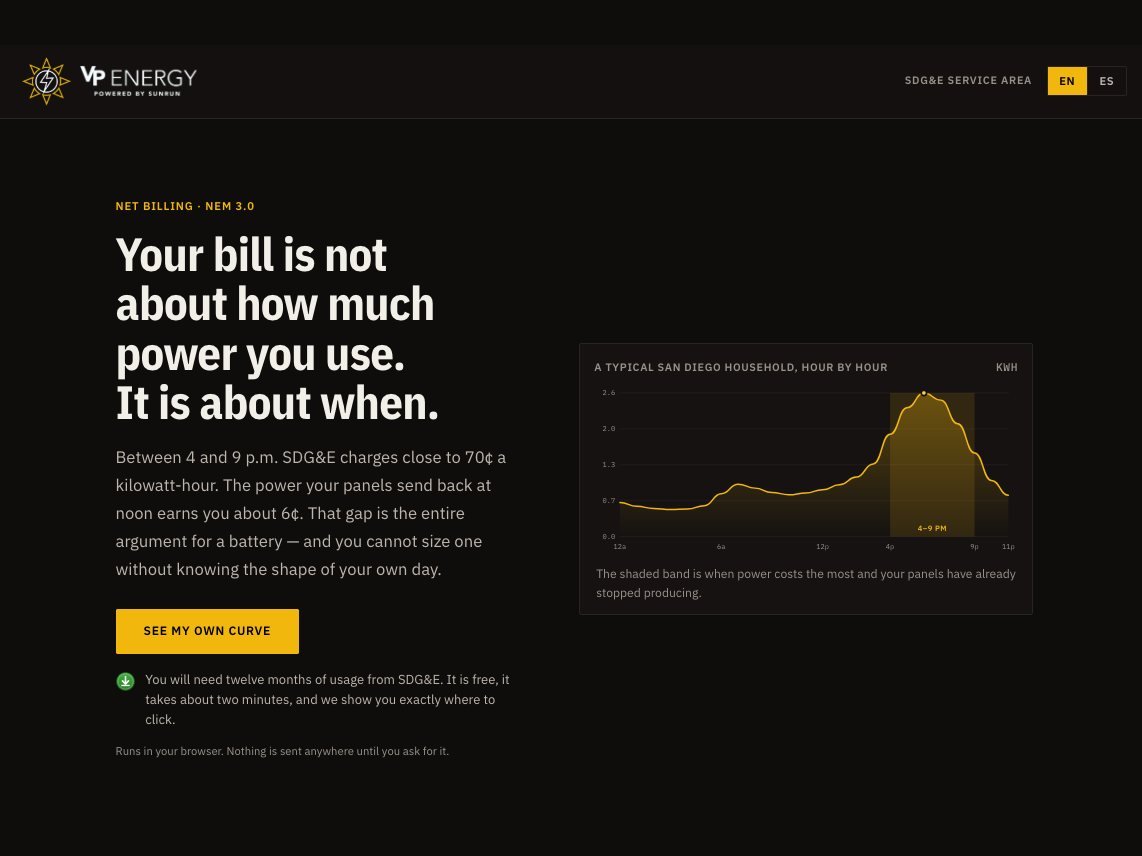
The headline does the arguing: your bill is not about how much power you use, it is about when. The chart shades the 4–9pm window — the hours power costs the most and the panels have already stopped producing.
The visitor uploads twelve months of SDG&E data, and the page tells them exactly where to click to get it. Two minutes, free, and it never leaves their browser.

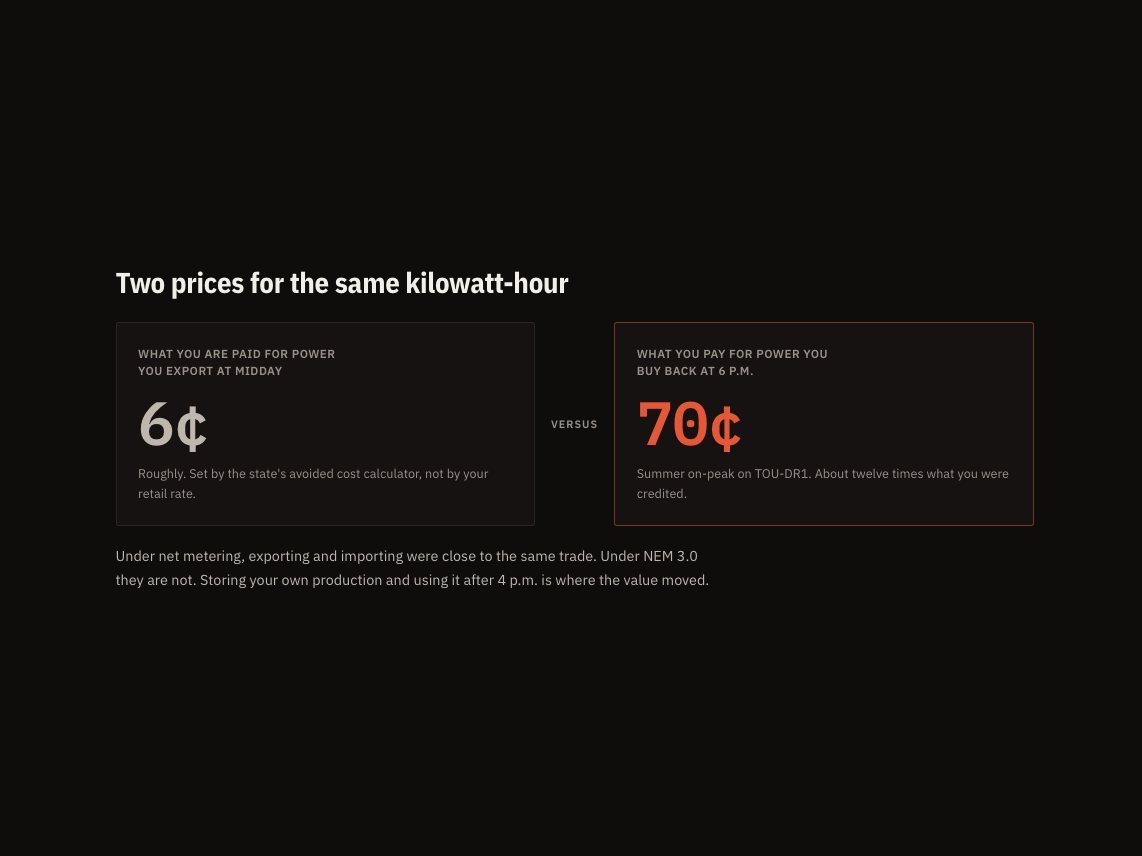
Six cents for the power you export at midday. Seventy cents to buy it back at 6pm — about twelve times what you were credited. Under old net metering those were close to the same trade; under NEM 3.0 they are not.
One screen, two numbers, no persuasion. That gap is the entire argument for a battery, so we built the page that shows it rather than the paragraph that claims it.

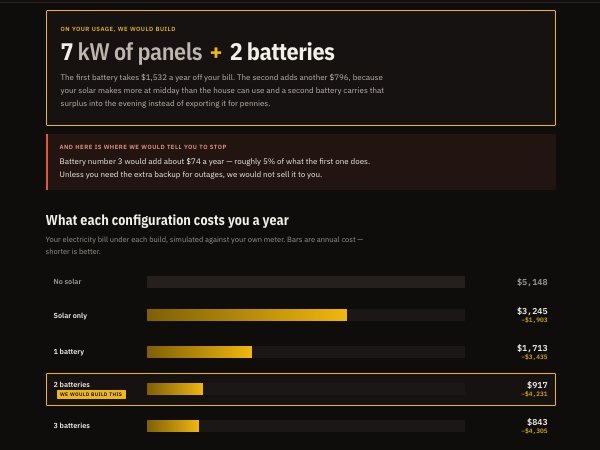
A full year of meter data, run hour by hour against one, two, and three batteries under NEM 3.0. On this usage the first battery takes $1,532 a year off the bill and the second adds another $796 — then the tool draws a line and says so.
Battery three would add about $74 a year, roughly 5% of what the first one does, and the page tells the visitor outright that unless they need the backup for outages, VP Energy would not sell it to them. A tool that talks a customer out of a bigger order is a strange thing to build. It is also why people finish it and call.
Hand-built pages and real image files — the same reasoning we apply to a fabrication spec, pointed at page weight instead of material cost. The whole site is bilingual, English and Spanish, which is not a nice-to-have in either South Florida or San Diego.
Four tools, two utility markets, two languages, and no sales visit to use any of them.
Scope it, draw it, build it, keep it running.
What does the site actually have to accomplish, and what would a visitor need to see to believe it? That question decides everything else.
Layout, type, and words together. We write copy as part of the job, because a page designed around placeholder text falls apart when the real text arrives.
Hand-built pages, tested on real phones, not just a desktop window dragged narrow. Any calculations get checked against source data.
Domain, hosting, forms, and analytics set up properly — then kept running and updated after launch instead of handed over and forgotten.
Same deadline discipline as the shop floor, pointed at a browser.
Fast, hand-built pages that load on a phone in a parking lot — not a template weighed down by plugins.
Estimators, configurators, and simulators that do real math on a visitor's own numbers and earn the call.
Domains, hosting, contact forms, and analytics set up properly, then kept running after launch.
Because the deadline does not care which department it lands in.
When the same team builds the activation and the site that drives people to it, the two match — the type, the colors, and the message stay put instead of drifting between vendors.
Boat shows and galas do not move. Neither does a launch. We have spent three decades delivering against dates that could not slip, which is a useful habit to bring to a website.
Copy, layout, and build come from the same place, so the page argues for something specific instead of filling a template with whatever the client sent over.
Anything not covered here, the contact form will reach us directly.
No. Plenty of web projects stand on their own. It is useful when the same shop handles the site and the physical build, because the two stay consistent — but it is not a requirement.
A calculator, estimator, configurator, or simulator that does real work on a visitor's own numbers instead of just describing what you offer. It is worth building when your product needs proving rather than announcing. If your claim is easy to believe, a well-built page is enough and we will tell you so.
It depends on scope — a landing page and a site with four working tools are very different jobs. Tell us what the site has to accomplish and your timeline, and we will scope it properly rather than quote a number blind.
Yes. The VP Energy site is fully bilingual, with a language toggle on every page. In South Florida that is usually the right call, not an add-on.
Yes. Hosting setup, domain configuration, contact forms, and analytics are part of the job, and we can keep the site maintained after launch rather than handing you a folder of files.
Either way works. We can build to brand guidelines and comps you already have, or take a project from a rough idea through copy, design, and build. Some clients arrive with everything locked; others have a deadline and an idea.
Tell us what the site has to accomplish and when you need it live. We will tell you straight away whether it is realistic.